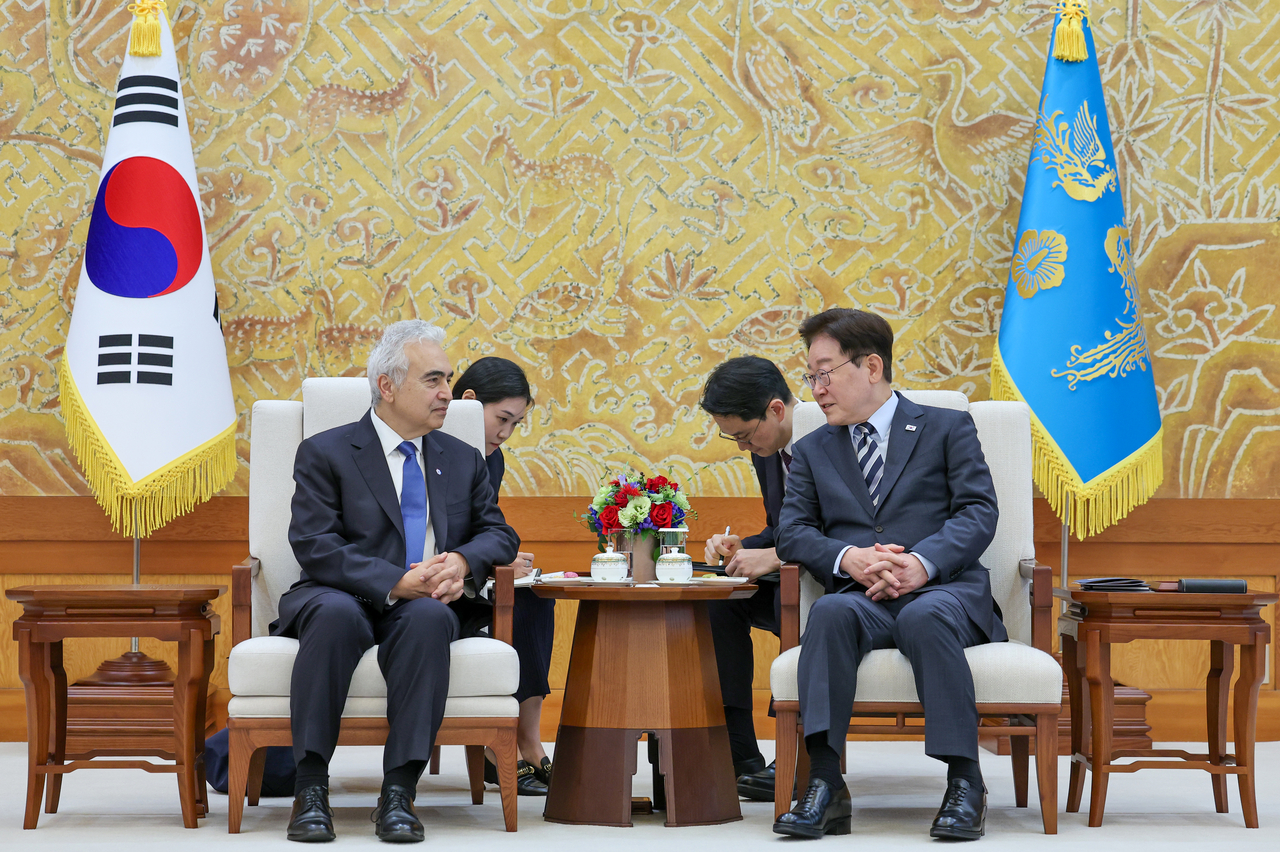
President Lee Jae Myung and International Energy Agency chief Fatih Birol discussed how to advance energy security cooperation in the Asia-Pacific on Thursday, as the Hormuz crisis exposes the region’s vulnerability to supply shocks.
The meeting came as the IEA coordinates an international response to the energy crisis triggered by the Iran war, with South Korea taking part as a full member of the agency.
Lee and Birol held “in-depth discussions on global energy and policy trends, ways to strengthen energy security through electrification and a new direction for energy cooperation in the Asia-Pacific,” senior presidential spokesperson Kang Yu-jung said in a written briefing.
Lee “stressed the need for cooperation to strengthen energy supply chain resilience in the Asia-Pacific region,” pledging South Korea’s “support for strengthening the energy capabilities of countries in the region in cooperation with the IEA,” Kang added.
The discussion followed up on Lee’s proposal at the Group of Seven summit in June to bolster energy supply-chain resilience across the region. At the time, Lee called for closer cooperation among energy-importing countries through information sharing, early-warning mechanisms, emergency coordination and measures to stabilize crude oil and petroleum supplies.
Lee also asked Birol how countries should respond as the Middle East conflict complicates efforts to shift their energy systems toward renewable sources.
“We are also in the process of overhauling our energy system around renewable energy, but the energy crisis triggered by the recent situation in the Middle East appears to be posing a major obstacle to that transition,” Lee said.
Lee called the situation “an important juncture for the Republic of Korea,” referring to South Korea by its official name.
The Iran war, which began on Feb. 28 with joint strikes by the United States and Israel, has effectively blockaded the Strait of Hormuz. The waterway is vital for global energy shipments; around 70 percent of Korea’s crude oil imports from the Middle East pass through the chokepoint.
South Korea, a full IEA member since 2002, also joined the agency’s mid-March decision to make 400 million barrels of oil from emergency reserves available to the market, the largest coordinated stock release in its history.
Responding to Lee, Birol said countries were increasingly turning to electrification to reduce reliance on imported fossil fuels and strengthen resilience to future shocks. The shift is driven by electric vehicles, industrial electrification, and rising power demand from artificial intelligence data centers and semiconductor manufacturing.
Birol commended the Korean government for “putting electrification at the center of your energy policy for the years to come.”
“I am going to tell the entire world what Korea has in mind because 2 1/2 years ago I said that the world is entering the age of electricity, and Korea is a very good example of that,” Birol said.
The IEA chief underlined that greater electrification would strengthen Korea’s energy sovereignty and economy while helping cut greenhouse gas emissions.
According to Kang, Birol specifically praised Korea for efforts to shield the public from the Middle East crisis; its industrial base in batteries, heavy electrical equipment and power grids; and its support for electrification in developing Asian countries.
Birol further noted that Korea’s auto industry could lead transportation electrification, citing its strong EV and battery manufacturing base as electric vehicles become more affordable.
During the meeting, Birol told Lee that he plans to propose at this year’s COP31 climate summit in Turkey a goal of raising electricity’s share of energy consumption to 35 percent by 2035, from about 23 percent currently, according to Kang.
The two also discussed nuclear power’s role in the energy transition.
Lee noted that the Middle East conflict appeared to be pushing some countries back toward greater reliance on fossil fuels while also increasing interest in nuclear power, and asked Birol for his assessment.
Birol cited France, Sweden, Britain and the Netherlands as countries preserving existing nuclear plants while expanding nuclear capacity.
The IEA chief added that renewable energy would firmly establish itself as the main source of power, while nuclear power, if used as a complementary source, could help reduce dependence on fossil fuels and cut greenhouse-gas emissions, according to Kang.
Birol’s visit to Korea followed stops in Beijing and Tokyo as part of his Asia tour and coincided with the three-day 2026 World Climate Industry Expo, which began Wednesday.
dagyumji@heraldcorp.com